Monday, June 20, 2005

As Toyota Goes ... (Friedman)

June 17, 2005

So I have a question: If I am rooting for General Motors to go bankrupt and be bought out by Toyota, does that make me a bad person?

It is not that I want any autoworker to lose his or her job, but I certainly would not put on a black tie if the entire management team at G.M. got sacked and was replaced by executives from Toyota. Indeed, I think the only hope for G.M.'s autoworkers, and maybe even our country, is with Toyota. Because let's face it, as Toyota goes, so goes America.

Having Toyota take over General Motors - which based its business strategy on building gas-guzzling cars, including the idiot Hummer, scoffing at hybrid technology and fighting Congressional efforts to impose higher mileage standards on U.S. automakers - would not only be in America's economic interest, it would also be in America's geopolitical interest.

Because Toyota has pioneered the very hybrid engine technology that can help rescue not only our economy from its oil addiction (how about 500 miles per gallon of gasoline?), but also our foreign policy from dependence on Middle Eastern oil autocrats.

Diffusing Toyota's hybrid technology is one of the keys to what I call "geo-green." Geo-greens seek to combine into a single political movement environmentalists who want to reduce fossil fuels that cause climate change, evangelicals who want to protect God's green earth and all his creations, and geo-strategists who want to reduce our dependence on crude oil because it fuels some of the worst regimes in the world.

The Bush team has been M.I.A. on energy since 9/11. Indeed, the utter indifference of the Bush team to developing a geo-green strategy - which would also strengthen the dollar, reduce our trade deficit, make America the world leader in combating climate change and stimulate U.S. companies to take the lead in producing the green technologies that the world will desperately need as China and India industrialize - is so irresponsible that it takes your breath away. This is especially true when you realize that the solutions to our problems are already here.

As Gal Luft, co-chairman of the Set America Free coalition, a bipartisan alliance of national security, labor, environmental and religious groups that believe reducing oil consumption is a national priority, points out: the majority of U.S. oil imports go to fueling the transport sector - primarily cars and trucks. Therefore, the key to reducing our dependence on foreign oil is powering our cars and trucks with less petroleum.

There are two ways we can do that. One is electricity. We don't import electricity. We generate all of our needs with coal, hydropower, nuclear power and natural gas. Toyota's hybrid cars, like the Prius, run on both gasoline and electricity that is generated by braking and then stored in a small battery. But, says Luft, if you had a hybrid that you could plug in at night, the battery could store up 20 miles of driving per day. So your first 20 miles would be covered by the battery. The gasoline would only kick in after that. Since 50 percent of Americans do not drive more than 20 miles a day, the battery power would cover all their driving. Even if they drove more than that, combining the battery power and the gasoline could give them 100 miles per gallon of gasoline used, Luft notes.

Right now Toyota does not sell plug-in hybrids. Some enthusiasts, though, are using kits to convert their hybrids to plug-ins, but that adds several thousand dollars - and you lose your Toyota warranty. Imagine, though, if the government encouraged, through tax policy and other incentives, every automaker to offer plug-in hybrids? We would quickly move down the innovation curve and end up with better and cheaper plug-ins for all.

Then add to that flexible-fuel cars, which have a special chip and fuel line that enable them to burn alcohol (ethanol or methanol), gasoline or any mixture of the two. Some four million U.S. cars already come equipped this way, including from G.M. It costs only about $100 a car to make it flex-fuel ready. Brazil hopes to have all its new cars flex-fuel ready by 2008. As Luft notes, if you combined a plug-in hybrid system with a flex-fuel system that burns 80 percent alcohol and 20 percent gasoline, you could end up stretching each gallon of gasoline up to 500 miles.

In short, we don't need to reinvent the wheel or wait for sci-fi hydrogen fuel cells. The technologies we need for a stronger, more energy independent America are already here. The only thing we have a shortage of now are leaders with the imagination and will to move the country onto a geo-green path.

Friday, June 17, 2005

Behind Every Grad... (Friedman)

June 10, 2005

You don't expect to learn much at a graduation ceremony - especially if you're the commencement speaker. But I learned about a truly important program at the Williams College graduation last Sunday.

Every year, in addition to granting honorary degrees, Williams also honors four high school teachers. But not just any high school teachers. Williams asks the 500 or so members of its senior class to nominate the high school teachers who had a profound impact on their lives. Then each year a committee goes through the roughly 50 student nominations, does its own research with the high schools involved and chooses the four most inspiring teachers.

Each of the four teachers is given $2,000, plus a $1,000 donation to his or her high school. The winners and their families are then flown to Williams, located in the lush Berkshires, and honored as part of the graduation weekend.

On the day before last Sunday's graduation, all four of the high school teachers, and the students who nominated them, sat on stage at a campuswide event, and the dean of the college talked about how and why each high school teacher had influenced the Williams student, reading from the students' nominating letters. Later, the four teachers were introduced at a dinner along with the honorary degree recipients.

"Every time we do this, one of the [high school] teachers says to me, 'This is one of the great weekends of my life,' " said Williams's president, Morton Owen Schapiro. "But it is great for us, too. ...

"When you are at a place like Williams and you are able to benefit from these wonderful kids, sometimes you take it for granted. You think we produce these kids. But as faculty members, we should always be reminded that we stand on the shoulders of great high school teachers, we get great material to work with: well educated, well trained, with a thirst for learning.

"So we have been doing our little part to recognize that. ... We take these teachers, who are not well compensated and often underappreciated, and give them a great weekend."

If you think these awards are not important for the teachers receiving them, then you don't know anything about teachers.

I hurried to get my cap and gown off so I could interview Myra Loris, an international relations teacher at Highland Park High School, north of Chicago, who specializes in preparing kids to take part in the Model U.N. program. She was nominated by Alice Brown, a Williams senior who said in her nominating letter that Ms. Loris was a "very important teacher, role model and mentor. ... Myra has inspired many students, like me, to pursue careers in law, international relations and political advocacy."

When she got the call from Williams saying she had won, Ms. Loris recalled, "I just kept saying, 'Wow.' " A teacher for 23 years, now nearing retirement, she added, "I just found it very affirming in a Zenlike way," an acknowledgement "that my days have value, my life has had some worth. Public school teachers don't get that very often," especially with No Child Left Behind restrictions, which now require teachers to teach to the tests, and push out the window "all those things that really spark kids imaginations" - like art and music.

Ms. Loris added, "A lot of my young colleagues were really excited and pleased for me, and everyone wants to hear when I get back what happened - and that is really important, because we are not getting people rushing into education. We send 90 percent of our kids on to college, but if you ask how many of them think of being teachers, you will get six kids. ...

"There are great teachers in our high school, outstanding teachers, and they don't get enough recognition. A lot of kids would not be in college without them."

We are heading into an age in which jobs are likely to be invented and made obsolete faster and faster. The chances of today's college kids working in the same jobs for the same companies for their whole careers are about zero. In such an age, the greatest survival skill you can have is the ability to learn how to learn. The best way to learn how to learn is to love to learn, and the best way to love to learn is to have great teachers who inspire.

And the best way to ensure that we have teachers who inspire their students is if we recognize and reward those who clearly have done so.

Imagine if every college in America had a program like Williams's, and every spring, across the land, thousands of great teachers were acknowledged by the students they inspired? "No Great Teachers Left Behind." How about it?

Let's Talk About Iraq (Friedman)

June 15, 2005

Ever since Iraq's remarkable election, the country has been descending deeper and deeper into violence. But no one in Washington wants to talk about it. Conservatives don't want to talk about it because, with a few exceptions, they think their job is just to applaud whatever the Bush team does. Liberals don't want to talk about Iraq because, with a few exceptions, they thought the war was wrong and deep down don't want the Bush team to succeed. As a result, Iraq is drifting sideways and the whole burden is being carried by our military. The rest of the country has gone shopping, which seems to suit Karl Rove just fine.

Well, we need to talk about Iraq. This is no time to give up - this is still winnable - but it is time to ask: What is our strategy? This question is urgent because Iraq is inching toward a dangerous tipping point - the point where the key communities begin to invest more energy in preparing their own militias for a scramble for power - when everything falls apart, rather than investing their energies in making the hard compromises within and between their communities to build a unified, democratizing Iraq.

Our core problem in Iraq remains Donald Rumsfeld's disastrous decision - endorsed by President Bush - to invade Iraq on the cheap. From the day the looting started, it has been obvious that we did not have enough troops there. We have never fully controlled the terrain. Almost every problem we face in Iraq today - the rise of ethnic militias, the weakness of the economy, the shortages of gas and electricity, the kidnappings, the flight of middle-class professionals - flows from not having gone into Iraq with the Powell Doctrine of overwhelming force.

Yes, yes, I know we are training Iraqi soldiers by the battalions, but I don't think this is the key. Who is training the insurgent-fascists? Nobody. And yet they are doing daily damage to U.S. and Iraqi forces. Training is overrated, in my book. Where you have motivated officers and soldiers, you have an army punching above its weight. Where you don't have motivated officers and soldiers, you have an army punching a clock.

Where do you get motivated officers and soldiers? That can come only from an Iraqi leader and government that are seen as representing all the country's main factions. So far the Iraqi political class has been a disappointment. The Kurds have been great. But the Sunni leaders have been shortsighted at best and malicious at worst, fantasizing that they are going to make a comeback to power through terror. As for the Shiites, their spiritual leader, Ayatollah Ali al-Sistani, has been a positive force on the religious side, but he has no political analog. No Shiite Hamid Karzai has emerged.

"We have no galvanizing figure right now," observed Kanan Makiya, the Iraqi historian who heads the Iraq Memory Foundation. "Sistani's counterpart on the democratic front has not emerged. Certainly, the Americans made many mistakes, but at this stage less and less can be blamed on them. The burden is on Iraqis. And we still have not risen to the magnitude of the opportunity before us."

I still don't know if a self-sustaining, united and democratizing Iraq is possible. I still believe it is a vital U.S. interest to find out. But the only way to find out is to create a secure environment. It is very hard for moderate, unifying, national leaders to emerge in a cauldron of violence.

Maybe it is too late, but before we give up on Iraq, why not actually try to do it right? Double the American boots on the ground and redouble the diplomatic effort to bring in those Sunnis who want to be part of the process and fight to the death those who don't. As Stanford's Larry Diamond, author of an important new book on the Iraq war, "Squandered Victory," puts it, we need "a bold mobilizing strategy" right now. That means the new Iraqi government, the U.S. and the U.N. teaming up to widen the political arena in Iraq, energizing the constitution-writing process and developing a communications-diplomatic strategy that puts our bloodthirsty enemies on the defensive rather than us. The Bush team has been weak in all these areas. For weeks now, we haven't even had ambassadors in Iraq, Afghanistan or Jordan.

We've already paid a huge price for the Rumsfeld Doctrine - "Just enough troops to lose." Calling for more troops now, I know, is the last thing anyone wants to hear. But we are fooling ourselves to think that a decent, normal, forward-looking Iraqi politics or army is going to emerge from a totally insecure environment, where you can feel safe only with your own tribe.

Monday, June 13, 2005

Bangalore: Hot and Hotter (Friedman)

June 8, 2005

By THOMAS L. FRIEDMAN

Bangalore, India

Every time I visit India, Indians always ask me to compare India with China. Lately, I have responded like this: If India and China were both highways, the Chinese highway would be a six-lane, perfectly paved road, but with a huge speed bump off in the distance labeled "Political reform: how in the world do we get from Communism to a more open society?" When 1.3 billion people going 80 miles an hour hit a speed bump, one of two things happens: Either the car flies into the air and slams down, and all the parts hold together and it keeps on moving - or the car flies into the air, slams down and all the wheels fall off. Which it will be with China, I don't know.

India, by contrast, is like a highway full of potholes, with no sidewalks and half the streetlamps broken. But off in the distance, the road seems to smooth out, and if it does, this country will be a dynamo. The question is: Is that smoother road in the distance a mirage or the real thing?
At first blush, coming back to Bangalore, India's Silicon Valley, that smoother road seems like a mirage. The infrastructure here is still a total mess. But looks can be deceiving. Beneath the mess, Bangalore is entering a mature new phase as a technology center by starting to produce its own high-tech products, research, venture capital firms and start-ups.

"The ecosystem for innovation is now starting to be created here," said Nandan Nilekani, the C.E.O. of Infosys. For several years now, when venture capitalists funded companies in the U.S., they insisted that the R.&D. for the products be done in India. But now, increasingly, Western companies will come up with a new idea and then tell Infosys, Wipro or Tata, India's premier technology companies, to research, develop and produce the whole thing.

As one Wipro executive put it, "You go from solving my problem to serving my business to knowing my business to being my business." What will be left for the Western companies is the "ideation," the original concept and design of a flagship product (which is a big deal), and then the sales and marketing.

"We're going from a model of doing piecework to where the entire product and entire innovation stream is done by companies here," Mr. Nilekani added. All of this means that innovation will happen faster and cheaper, with much more global collaboration.

The best indication that Bangalore is becoming hot is how many foreign techies - non-Indians - are now coming here to work. P. Anandan, an Indian-American who worked for Microsoft for 28 years in Redmond, Wash., just opened Microsoft's research center in Bangalore, which follows the ones in Redmond, Cambridge and Beijing.

"I have two non-Indians working for me here, one Japanese and one American, and they could work anywhere in the world," Mr. Anandan said. He added that when he got his engineering degree in India 28 years ago, all the competition was to get a job abroad. Now the fiercest competition is to get an I.T. job in India: "It is no longer, 'Well I have to stay here,' but, 'Do I get a chance to stay here?' "

In the past year, Infosys received 9,600 applications from abroad, including from China, France and Germany, for internships, and it accepted 100. I asked one of these interns, Vicki Chen, a Chinese-American business student from the Claremont Colleges, why she came. "All the business is coming to India, and I don't see why I shouldn't follow the business," she said. "If this is where the center of gravity is, you should go check it out, and then you become more valuable."

Even more interesting is how Indian firms are taking the skills they learned from outsourcing and using them to develop low-cost products for the low-wage Indian market: a medical insurance plan for the poor for as little as $10 a year, a $2,000 car, a $200 laptop, supercheap cellphones, a low-fare airline ($75 one-way for the three-hour Bangalore-Delhi flight) that sells tickets from Internet kiosks in gas stations. Indian companies know that if they can make money producing low-cost technology for poor Indians, it gives them an incredible platform to then take these products global. (Imagine the profit potential if they work in the West?) China is doing the exact same thing.

Indeed, I now understand why, when China's prime minister, Wen Jiabao, visited India for the first time last April, he didn't fly into the capital, New Delhi - as foreign leaders usually do. He flew directly from Beijing to Bangalore - for a tech-tour - and then went on to New Delhi.

No U.S. president or vice president has ever visited Bangalore.

Monday, June 06, 2005

America's DNA (Friedman)

New Delhi

A few years ago my youngest daughter participated in the National History Day program for eighth graders. The question that year was "turning points" in history, and schoolchildren across the land were invited to submit a research project that illuminated any turning point in history. My daughter's project was "How Sputnik Led to the Internet." It traced how we reacted to the Russian launch of Sputnik by better networking our scientific research centers and how those early, crude networks spread and eventually were woven into the Internet. The subtext was how our reaction to one turning point unintentionally triggered another decades later.

I worry that 20 years from now some eighth grader will be doing her National History Day project on how America's reaction to 9/11 unintentionally led to an erosion of core elements of American identity. What sparks such dark thoughts on a trip from London to New Delhi?

In part it is the awful barriers that now surround the U.S. Embassy in London on Grosvenor Square. "They have these cages all around the embassy now, and these huge concrete blocks, and the whole message is: 'Go away!' " said Kate Jones, a British literary agent who often walks by there. "That is how people think of America now, and it's a really sad thing because that is not your country."

In part it was a conversation with friends in London, one a professor at Oxford, another an investment banker, both of whom spoke about the hassles, fingerprinting, paperwork and costs that they, pro-American professionals, now must go through to get a visa to the U.S.

In part it was a recent chat with the folks at Intel about the obstacles they met trying to get visas for Muslim youths from Pakistan and South Africa who were finalists for this year's Intel science contest. And in part it was a conversation with M.I.T. scientists about the new restrictions on Pentagon research contracts - in terms of the nationalities of the researchers who could be involved and the secrecy required - that were constricting their ability to do cutting-edge work in some areas and forcing intellectual capital offshore. The advisory committee of the World Wide Web recently shifted its semiannual meeting from Boston to Montreal so as not to put members through the hassle of getting visas to the U.S.

The other day I went to see the play "Billy Elliot" in London. During intermission, a man approached me and asked, "Are you Mr. Friedman?" When I said yes, he introduced himself - Emad Tinawi, a Syrian-American working for Booz Allen. He told me that while he disagreed with some things I wrote, there was one column he still keeps. "It was the one called, 'Where Birds Don't Fly,' " he said.

I remembered writing that headline, but I couldn't remember the column. Then he reminded me: It was about the new post-9/11 U.S. Consulate in Istanbul, which looks exactly like a maximum-security prison, so much so that a captured Turkish terrorist said that while his pals considered bombing it, they concluded that the place was so secure that even birds couldn't fly there. Mr. Tinawi and I then swapped impressions about the corrosive impact such security restrictions were having on foreigners' perceptions of America.

In New Delhi, the Indian writer Gurcharan Das remarked to me that with each visit to the U.S. lately, he has been forced by border officials to explain why he is coming to America. They "make you feel so unwanted now," said Mr. Das. America was a country "that was always reinventing itself," he added, because it was a country that always welcomed "all kinds of oddballs" and had "this wonderful spirit of openness." American openness has always been an inspiration for the whole world, he concluded. "If you go dark, the world goes dark."

Bottom line: We urgently need a national commission to look at all the little changes we have made in response to 9/11 - from visa policies to research funding, to the way we've sealed off our federal buildings, to legal rulings around prisoners of war - and ask this question: While no single change is decisive, could it all add up in a way so that 20 years from now we will discover that some of America's cultural and legal essence - our DNA as a nation - has become badly deformed or mutated?

This would be a tragedy for us and for the world. Because, as I've argued, where birds don't fly, people don't mix, ideas don't get sparked, friendships don't get forged, stereotypes don't get broken, and freedom doesn't ring.

A Race to the Top (Friedman)

June 3, 2005

Bangalore, India

It was extremely revealing traveling from Europe to India as French voters (and now Dutch ones) were rejecting the E.U. constitution - in one giant snub to President Jacques Chirac, European integration, immigration, Turkish membership in the E.U. and all the forces of globalization eating away at Europe's welfare states. It is interesting because French voters are trying to preserve a 35-hour work week in a world where Indian engineers are ready to work a 35-hour day. Good luck.

Voters in "old Europe" - France, Germany, the Netherlands and Italy - seem to be saying to their leaders: stop the world, we want to get off; while voters in India have been telling their leaders: stop the world and build us a stepstool, we want to get on. I feel sorry for Western European blue collar workers. A world of benefits they have known for 50 years is coming apart, and their governments don't seem to have a strategy for coping.

One reason French voters turned down the E.U. constitution was rampant fears of "Polish plumbers." Rumors that low-cost immigrant plumbers from Poland were taking over the French plumbing trade became a rallying symbol for anti-E.U. constitution forces. A few weeks ago Franz Müntefering, chairman of Germany's Social Democratic Party, compared private equity firms - which buy up failing businesses, downsize them and then sell them - to a "swarm of locusts."

The fact that a top German politician has resorted to attacking capitalism to win votes tells you just how explosive the next decade in Western Europe could be, as some of these aging, inflexible economies - which have grown used to six-week vacations and unemployment insurance that is almost as good as having a job - become more intimately integrated with Eastern Europe, India and China in a flattening world.

To appreciate just how explosive, come to Bangalore, India, the outsourcing capital of the world. The dirty little secret is that India is taking work from Europe or America not simply because of low wages. It is also because Indians are ready to work harder and can do anything from answering your phone to designing your next airplane or car. They are not racing us to the bottom. They are racing us to the top.

Indeed, there is a huge famine breaking out all over India today, an incredible hunger. But it is not for food. It is a hunger for opportunity that has been pent up like volcanic lava under four decades of socialism, and it's now just bursting out with India's young generation.

"India is the oldest civilization, the largest democracy and the youngest population - almost 70 percent is below age 35 and almost 50 percent is 25 and under," said Shekhar Gupta, editor of The Indian Express. Next to India, Western Europe looks like an assisted-living facility with Turkish nurses.

Sure, a huge portion of India still lives in wretched slums or villages, but more and more of the young cohort are grasping for something better. A grass-roots movement is now spreading, demanding that English be taught in state schools - where 85 percent of children go - beginning in first grade, not fourth grade. "What's new is where this movement is coming from," said the Indian commentator Krishna Prasad. "It's coming from the farmers and the Dalits, the lowest groups in society." Even the poor have been to the cities enough to know that English is now the key to a tech-sector job, and they want their kids to have those opportunities.

The Indian state of West Bengal has the oldest elected Communist government left in the world today. Some global technology firms recently were looking at outsourcing there, but told the Communists they could not do so because of the possibility of worker strikes that might disrupt the business processes of the companies they work for. No problem. The Communist government declared information technology work an "essential service," making it illegal for those workers to strike. Have a nice day.

"This is not about wages at all - the whole wage differential thing is going to reduce very quickly," said Rajesh Rao, who heads the innovative Indian game company, Dhruva. It is about people who have been starving "finally seeing the ability to realize their dreams." Both Infosys and Wipro, India's leading technology firms, received more than one million applications last year for a little more than 10,000 job openings.

Yes, this is a bad time for France and friends to lose their appetite for hard work - just when India, China and Poland are rediscovering theirs.

Paul Krugman is on vacation.

Wednesday, June 01, 2005

Just Shut It Down (Friedman)

May 27, 2005
London

By THOMAS L. FRIEDMAN

Shut it down. Just shut it down.

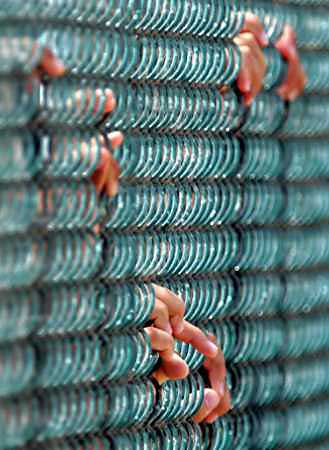
I am talking about the war-on-terrorism P.O.W. camp at Guantánamo Bay. Just shut it down and then plow it under. It has become worse than an embarrassment. I am convinced that more Americans are dying and will die if we keep the Gitmo prison open than if we shut it down. So, please, Mr. President, just shut it down.

The image “http://photos1.blogger.com/img/223/3272/640/guantanamo.jpg” cannot be displayed, because it contains errors.

If you want to appreciate how corrosive Guantánamo has become for America's standing abroad, don't read the Arab press. Don't read the Pakistani press. Don't read the Afghan press. Hop over here to London or go online and just read the British press! See what our closest allies are saying about Gitmo. And when you get done with that, read the Australian press and the Canadian press and the German press.

It is all a variation on the theme of a May 8 article in The Observer of London that begins, "An American soldier has revealed shocking new details of abuse and sexual torture of prisoners at Guantánamo Bay in the first high-profile whistle-blowing account to emerge from inside the top-secret base." Google the words "Guantánamo Bay and Australia" and what comes up is an Australian ABC radio report that begins: "New claims have emerged that prisoners at Guantánamo Bay are being tortured by their American captors, and the claims say that Australians David Hicks and Mamdouh Habib are among the victims."

Just another day of the world talking about Guantánamo Bay.

Why care? It's not because I am queasy about the war on terrorism. It is because I want to win the war on terrorism. And it is now obvious from reports in my own paper and others that the abuse at Guantánamo and within the whole U.S. military prison system dealing with terrorism is out of control. Tell me, how is it that over 100 detainees have died in U.S. custody so far? Heart attacks? This is not just deeply immoral, it is strategically dangerous.

I can explain it best by analogy. For several years now I have argued that Israel needed to get out of the West Bank and Gaza, and behind a wall, as fast as possible. Not because the Palestinians are right and Israel wrong. It's because Israel today is surrounded by three large trends. The first is a huge population explosion happening all across the Arab world. The second is an explosion of the worst interpersonal violence between Israelis and Palestinians in the history of the conflict, which has only recently been defused by a cease-fire. And the third is an explosion of Arabic language multimedia outlets - from the Internet to Al Jazeera.

What was happening around Israel at the height of the intifada was that the Arab multimedia explosion was taking the images of that intifada explosion and feeding them to the Arab population explosion, melding in the minds of a new generation of Arabs and Muslims that their enemies were J.I.A. - "Jews, Israel and America." That is an enormously toxic trend, and I hope Israel's withdrawal from Gaza will help deprive it of oxygen.

I believe the stories emerging from Guantánamo are having a similar toxic effect on us - inflaming sentiments against the U.S. all over the world and providing recruitment energy on the Internet for those who would do us ill.

Husain Haqqani, a thoughtful Pakistani scholar now teaching at Boston University, remarked to me: "When people like myself say American values must be emulated and America is a bastion of freedom, we get Guantánamo Bay thrown in our faces. When we talk about the America of Jefferson and Hamilton, people back home say to us: 'That is not the America we are dealing with. We are dealing with the America of imprisonment without trial.' "

Guantánamo Bay is becoming the anti-Statue of Liberty. If we have a case to be made against any of the 500 or so inmates still in Guantánamo, then it is high time we put them on trial, convict as many possible (which will not be easy because of bungled interrogations) and then simply let the rest go home or to a third country. Sure, a few may come back to haunt us. But at least they won't be able to take advantage of Guantánamo as an engine of recruitment to enlist thousands more. I would rather have a few more bad guys roaming the world than a whole new generation.

"This is not about being for or against the war," said Michael Posner, the executive director of Human Rights First, which is closely following this issue. "It is about doing it right. If we are going to transform the Middle East, we have to be law-abiding and uphold the values we want them to embrace - otherwise it is not going to work."

Thursday, May 26, 2005

The Best P.R.: Straight Talk (Friedman)

May 20, 2005

The fact that the White House spokesman Scott McClellan spent part of his briefing on Tuesday excoriating Newsweek - and telling its editors that they had a responsibility to "help repair the damage" to America's standing in the Arab-Muslim world - while not offering a single word of condemnation for those who went out and killed 16 people in Afghanistan in riots linked to a Newsweek report, pretty much explains why we're struggling to win the war of ideas in the Muslim world today. We are spending way too much time debating with ourselves, or playing defense, and way too little time actually looking Arab Muslims in the eye and telling them the truth as we see it.

In part this is because we are so dependent on their oil - and addicts never tell the truth to their pushers. In part this is because the administration got so carried away by the vote in the Iraqi elections that it lost focus. (We don't even have an ambassador in Iraq at this critical juncture, when it is so important that an ethnically balanced Iraqi government be formed. But don't worry - John Bolton is going to reform the U.N.)

And in part this is because we are afraid to say the truth, because we - wrongly - believe these people are incapable of rational thought and will just react violently. Therefore, if we have an information campaign, it must all be about explaining to them who we are, and why we are not bad people, and why Newsweek made a mistake. It must never involve us asking who they are and why they are behaving in ways that don't live up to the values they profess.

Instead of sending Mr. McClellan out to flog Newsweek, President Bush should have said: "Let me say first to all Muslims that desecrating anyone's holy book is utterly wrong. These allegations will be investigated, and any such behavior will be punished. That is how we Americans intend to look in the mirror. But we think the Arab-Muslim world must also look in the mirror when it comes to how it has been behaving toward an even worse crime than the desecration of God's words, and that is the desecration of God's creations. In reaction to an unsubstantiated Newsweek story, Muslims killed 16 other Muslims in Afghanistan in rioting, and no one has raised a peep - as if it were a totally logical reaction. That is wrong.

"In Iraq, where Shiite, Kurdish and Sunni Muslims are struggling to build a pluralistic new order, other Muslims, claiming to act in the name of Allah, are indiscriminately butchering people, without a word of condemnation coming from Muslim spiritual or political leaders. I don't understand a concept of the sacred that says a book is more sacred than a human life. A holy book, whether the Bible or the Koran, is only holy to the extent that it shapes human life and behavior.

"Look, Newsweek may have violated journalistic rules, but what jihadist terrorists are doing in Iraq and Afghanistan - blowing up innocent Muslims struggling to build an alternative society to dictatorship - surely destroys the Koran. They are the real enemies of Islam because they are depriving Muslims of a better future. From what I know of Islam, it teaches that you show reverence to God by showing reverence for his creations, not just his words. Why don't your spiritual leaders say that? I am asking, because I want to know."

Fortunately, a few courageous Arab intellectuals, such as Abderrahman al-Rashed, have asked such things. Writing in Wednesday's Saudi daily Asharq Al Awsat, he said: "When thousands in Afghanistan are concerned about a report in a magazine that does not reach them, written in a language they do not speak, leading them to protest in a manner unprecedented among other Islamic nations that do speak English, the matter is worth pursuing further: it tells us more about the dangers of propaganda and its exploitation by opposition groups than it does about spontaneous popular sentiments."

And a few days ago, a group of Iraqi journalists actually went to Jordan and got right in the face of Jordanian columnists and editors, demanding to know why they were treating Muslim mass murderers in Iraq like anticolonial war heroes. It's already changed the tone. That's the war of ideas.

The greatest respect we can show to Arabs and Muslims - and the best way to help Muslim progressives win the war of ideas - is to take them seriously and stop gazing at our own navels. That means demanding that they answer for their lies, hypocrisy and profane behavior, just as much as we must answer for ours.